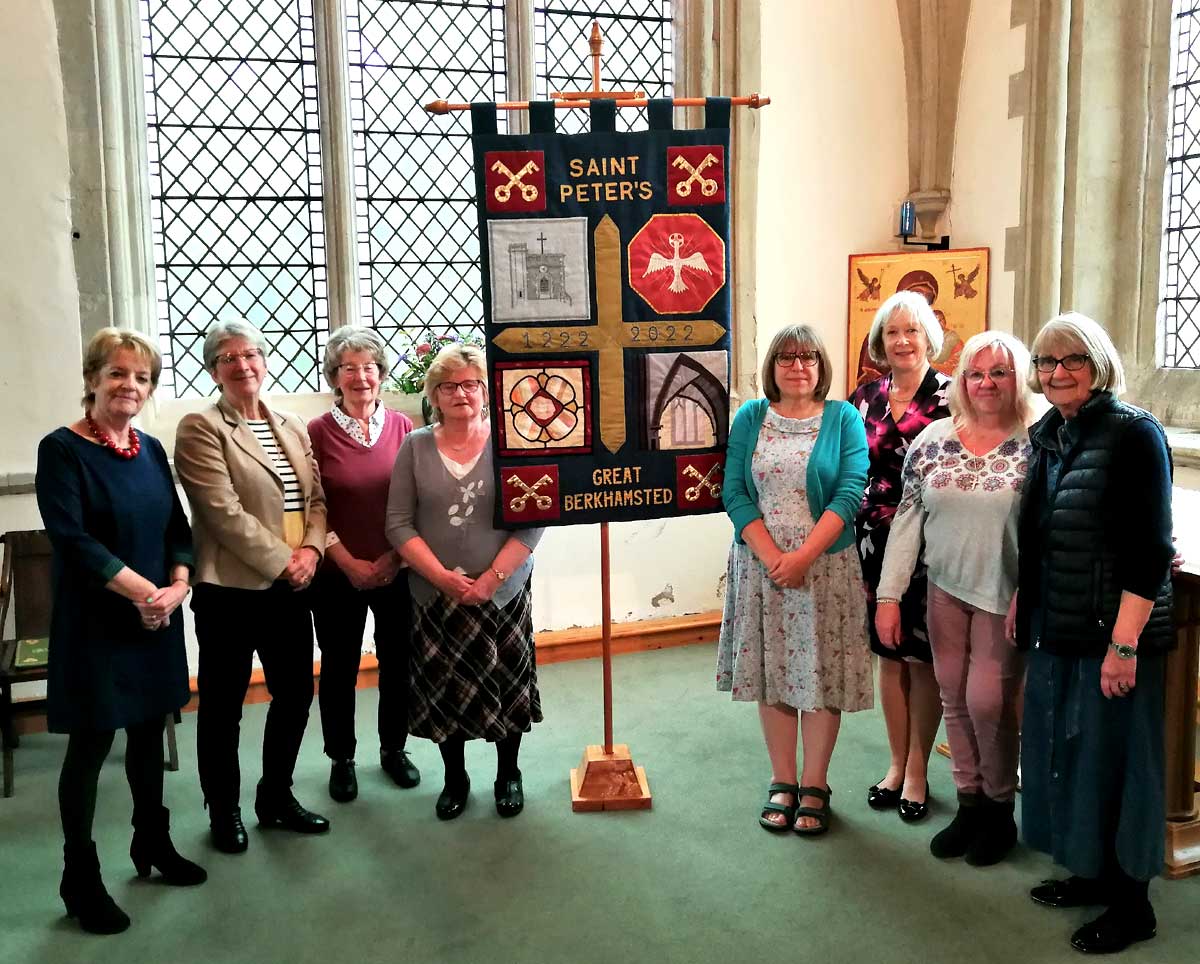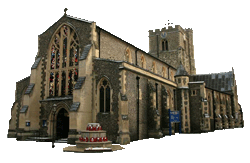
St Peter’s was built in 1222 just a few short years after the Magna Carta was signed and has been here for the people of Berkhamsted through the centuries. We’ve witnessed a siege at Berkhamsted Castle, the Crusades, two World Wars, the growth of a bustling market town and so many life events – baptisms, marriages and funerals – for past residents of our town.
Scroll down to take a journey through time…
Before 1222: Until St Peter’s is built, the parish church of the parish of Berkhamsted is centred on the church we now know as St Mary’s Northchurch

St Mary’s Northchurch is the oldest church in the area, and it traces its origins back to Saxon times. Berkhamsted only emerges as a town after the Norman Conquest. After St Peter’s Church is built, the focus of ecclesiastical power shifts a mile south down the road to the newer town of Berkhamsted, closer to the Castle, and St Mary’s comes to be known as “the North Church”.
1200: It is thought that the work of building St Peter’s began about this date.
1215: England is gripped by the Barons’ War, and Prince Louis of France invades and lays siege to Berkhamsted Castle. This crisis may have interrupted the building of the church.
St Peter’s parish records begin in 1222, during the reign of King Henry III. At this time, the Great Berkhamsted Parish lies within the Diocese of Lincoln, a huge territory that stretches from the Humber down as far as London.

Robert de Tuardo, the first known Rector of Great Berkhamsted, is installed in 1222 by the Bishop of Lincoln, Hugh of Wells. Hugh canonised his predecessor Hugh of Avalon (Saint Hugo of Lincoln) in 1220. Today, a Victorian stained-glass window in St Peter’s depicts Saint Hugh with his constant companion, a white swan, remembering our ancient links with Lincoln.

In the early years, the church is built in stages:
*Historians Norris and Cobb consider that the clerestory dates from about 1450, but it is now thought to be earlier

From the foundation of St Peter’s in 1222, the advowson – the right to present a new parish rector to the bishop – rested with the Abbot Grestein Abbey in Normandy, a remnant of Norman domination since 1066.
In 1381, this changes when Rev Peter de Burton is presented by King Richard II. This establishes a new tradition of the reigning monarch acting as patron to each new rector.
In the medieval era, bubonic plague is rife, and there is evidence of this in the rapid succession of rectors between 1369 and 1386, when St Peter’s has eight rectors, the shortest being Thomas Payne, who lasts only nine days!
John de Waltham serves as rector of St Peter’s 1379-1380. He is an important figure in the Church, becoming Bishop of Salisbury in 1388. He is also a favourite and close friend of King Richard II, who later appoints him Lord Privy Seal, and Lord Treasurer. After Waltham’s death, Richard honours him with a tomb in Westminster Abbey in the Chapel of Edward the Confessor, the only person not of royal blood to be buried in the royal chapel.

During the medieval era, Berkhamsted Castle is an active military fortress and often a royal residence. Many townsfolk have connections with the castle, among them Henry of Berkhamsted, a knight who serves as Constable of Berkhamsted Castle under Edward the Black Prince and fights with the prince at the Battle of Crécy in 1346. It is thought that a stone chest tomb in the St Peter’s Church is the tomb of Henry and his lady wife.
Other parishioners from the 14th century include Richard Torrington (d.1356) and John Raven, squire to the Black Prince, both of whom are commemorated with monumental brasses in the church, depicted in full medieval battle armour. Raven gives his name to Ravens Lane, a nearby street.
In the 15th and 16th centuries, the Incents are an important Berkhamsted family. Robert Incent (d.1485) serves as Secretary to Cecily Neville, Duchess of York, at Berkhamsted Castle. Monumental brasses in the church record that Robert and his wife Katherine (d.1521) donated to the ornamentation of the church and to the St John Chantry.

In 1527, Pope Clement VII refuses King Henry VIII’s request to annul his marriage to Catherine of Aragon. The enraged Henry splits the English Church from the Roman Catholic Church, and from 1534 he styles himself “Supreme Head on earth of the Church of England” in place of the Pope.
This act triggers a chain of events that leads to the English Reformation and creates the Church of England as a distinct entity, “both catholic and reformed”.
John Incent, the son of Robert and Katherine Incent, becomes an important figure in the religious turmoil of the 16th century. He serves as an agent of Thomas Cromwell, helping to confiscate religious properties during the Dissolution of the Monasteries. In 1540, John Incent becomes Dean of St Paul’s Cathedral, and in 1541 he founds the Berkhamsted School. The Incent family house, which still stands on the High Street opposite the church, is today known as “Dean Incent’s House”.

In 1580, Queen Elizabeth I leases Berkhamsted Castle to Sir Edward Carey (or Cary), the Keeper of the Crown Jewels. He plunders the derelict castle for stones to build his mansion, Berkhamsted Place. In 1596, Sir Adolphus Carey, Edward’s brother, leases the mansion. Adolphus is known Berkhamsted as “a most loving benefactor to the poor of this town”. He dies of smallpox in 1609 and is buried at St Peter’s. Adolphus’s funerary helmet is displayed for years in St Peter’s, hanging above the tomb of Henry of Berkhamsted, before it is stolen in the 1970s. It has never been recovered.

In the 17th century, England is in the grip of the Civil War. After the Siege of Colchester the summer of 1648, the Parliamentarian commander, Sir Thomas Fairfax, uses St Peter’s Church to imprison captured Royalist soldiers. With the church now full of wounded men, the churchwardens are forced to take out the windows to increase ventilation. A lot of medieval glass is probably lost at this time.

Anne Murray, a local parishioner who lives at Berkhamsted Place, becomes embroiled in a Royalist plot to smuggle the young Duke of York (later King James II) out of the country.
There is a a memorial in St Peter’s to her brothers, James and John Murray, who died young, before the Civil War hostilities.

One of Oliver Cromwell’s foremost henchmen, Daniel Axtell, is born in Berkhamsted and baptised in St Peter’s in 1622. Axtell serves in Cromwell’s forces in Ireland, before returning to Berkhamsted in 1656 to live at Berkhamsted Place. After the Restoration of the Monarchy, Axtell is executed at Tyburn in 1660 for his role in the execution of King Charles I.
During the Civil War, priests with Royalist sympathies are ejected from office and “intruder” priests are installed in churches by Parliament. The Rector of St Peter’s Berkhamsted, Rev John Napier, is ejected in 1650 and returns in 1661, but his replacement in that time is not recorded on the list of Rectors displayed in the church.

In the 17th century, Puritan iconoclasts are zealously destroying church monuments across the country, and whitewash over medieval wall paintings in St Peter’s, including images of the Eleven Apostles and Saint George and the Dragon on the pillars. Similar wall paintings have survived in other churches in the area, including in All Saints Little Kimble, St John the Baptist Little Missenden and St Albans Abbey.

After the Restoration of the Monarchy in 1660, peace and prosperity returns to England. Parliamentarian sympathisers fall out of favour, and Royalists are rewarded for their loyalty. Berkhamsted parishioner John Sayer, who has been in exile with the royals during the Commonwealth, returns to Berkhamsted and is appointed chief cook to King Charles II.

An entry in the Diary of Samuel Pepys from September 1661 records a hearty drinking session in Sayer’s wine cellar: “By my troth, we were very merry, and I drank so much wine that I was not fit for business.”
Sayer dies a wealthy man in 1682, and a lavish marble chest tomb in St Peter’s Church records his piety and generosity. Sayer bequeaths £1000 for the relief of the poor, and in 1684 the row of almshouses is built on Berkhamsted High Street to house poor widows.

In 1722, the duty of patronage shifts from the reigning monarch to the Prince of Wales when the heir to the throne, Prince George, Duke of Cornwall (the future George II), presents Rev John Cowper as Rector. After this, rectors of St Peter’s are presented by the Dukes of Cornwall, reflecting the ancient connection between Berkhamsted Castle and the Duchy of Cornwall. This tradition lasts until the 1860s.

From 1722 to 1756, Rev John Cowper serves as rector of St Peter’s. His son, William Cowper, is born in Berkhamsted rectory and is baptised in St Peter’s Church in 1731. William later finds fame as a poet and hymnodist, and writes many popular Evangelical hymns, including Oh! for a closer walk with God and There is a fountain fill’d with blood. Cowper’s hymns gave the English language the phrase “God moves in a mysterious way”.
Cowper poetry’s has been admired by both Samuel Taylor Coleridge and William Wordsworth.
Cowper’s faith leads him to become an active Abolitionist, joining William Wilberforce in the anti-slavery movement. Cowper’s 1788 poem, The Negro’s Complaint, argues passionately for an end to the slave trade. Nearly 200 years later in the 1960s, Martin Luther King quotes Cowper’s words in his protest speeches.
Today, two windows in St Peter’s Church commemorate Cowper’s life and writing.

Over the years the fabric of the church building has decayed. A 1628 record describes St Peter’s as “a large and goodly church for the publique service of Almighty God, which by reason of antiquity and former neglect is very much and dangerously decayed.” In the 1700s, the Chantry ceiling collapses, narrowly missing the boys and masters of Berkhamsted School.

1809: A cannon is hoisted onto the roof of St Peter’s and a salvo fired to celebrate the Golden Jubilee of King George III. This must have been quite an occasion!

Jeffry Wyattville, architect of Ashridge House, carries out a major restoration of the St Peter’s Church. His drastic “improvements” include tearing ancient memorials down from the walls. He also covers the outer walls of the church with stucco (plaster), moves the medieval chest tomb from the nave into the north transept, and removes a musicians’ gallery from the east end.

Although mechanical clocks have been in use since the 13th century, they are a luxury. In the early 14th century, an astronomical clock designed by Richard of Wallingford is installed at St Albans Abbey. St Peter’s Berkhamsted gets it first clock in 1838, built by Thwaites & Read of Clerkenwell and installed to celebrate the accession of Queen Victoria to the throne. The bells of St Peter’s are also recast.

In 1837, the borders of the vast Diocese of Lincoln are redrawn. Hertfordshire parishes such as Great Berkhamsted are moved into Diocese of Rochester. In 1877, a new Bishopric of St Albans is created with St Albans Abbey as its cathedral church. Since then, Great Berkhamsted has been part of the Diocese of St Albans, which covers Bedfordshire, Hertfordshire and parts of north London.

The population growth during the Industrial Revolution means that many town churchyards began to run out of space for new burials. The St Peter’s churchyard has been the final resting place of the town’s deceased for centuries, but now it is full up.
Charlotte, Countess of Bridgewater (widow of the 7th Earl of Bridgewater) donates an acre of land on Rectory Lane, and a new cemetery is opened. It is extended several times before it closes in 1954.
Rectory Lane Cemetery
Rev John Crofts, Rector of St Peter’s Church 1810-1851, builds a new Rectory on Rectory Lane to replace the old 17th-century house. This large, red-brick house is the home of many Berkhamsted rectors until it is sold it in the 1960s, and a new, more modest house is built on the site of the original Rectory. The Victorian rectory is today a private house.

The last rector of St Peter’s to be presented by a royal patron is Rev James Hutchinson (installed in 1851 with Prince Albert Edward, eldest son of Queen Victoria, as patron). In 1862, the local Duchy of Cornwall estates are sold to the Ashridge Estate, and rectors of Great Berkhamsted have since been presented by Earls of Brownlow.

Another renovation of St Peter’s is begun by the Victorian architect William Butterfield. Among his changes, he raises the roof of the south transept, re-floors the nave, demolishes a vestry building, installs new oak benches, removes a chamber at the west end that had been used to house the town fire engine, and replaces Wyattville’s crumbling exterior plaster with flint. Many medieval features are removed, including the remains of the paintings on the pillars. To mark the completion of the work, the Archbishop of Canterbury preaches at St Peter’s in January 1888.
Rev John Wolstenholme Cobb serves as Rector from 1871. He is an enthusiastic historian and documents the history of Berkhamsted Castle. His book, The History and Antiquities of Berkhamsted (1855) is still used by historians today. Cobb is appointed Rector just before the completion of Butterfield’s restoration work, and there are further improvements to the church during his incumbency. Cobb dies in office in 1883, and he is buried with great ceremony in Rectory Lane Cemetery

In the Great War of 1914–18, 200 men and boys from Berkhamsted are killed in action. Most are buried in the battlefield Cemeteries of Belgium and France; some who died at home are buried in St Peter’s Cemetery on Rectory Lane. In 1920, a War Memorial is erected on the corner of Water Lane, and another inside St Peter’s Church. After the Second World War, more names are added to the memorial. In the 1950s the town war memorial is moved to its present position next to St Peter’s church.

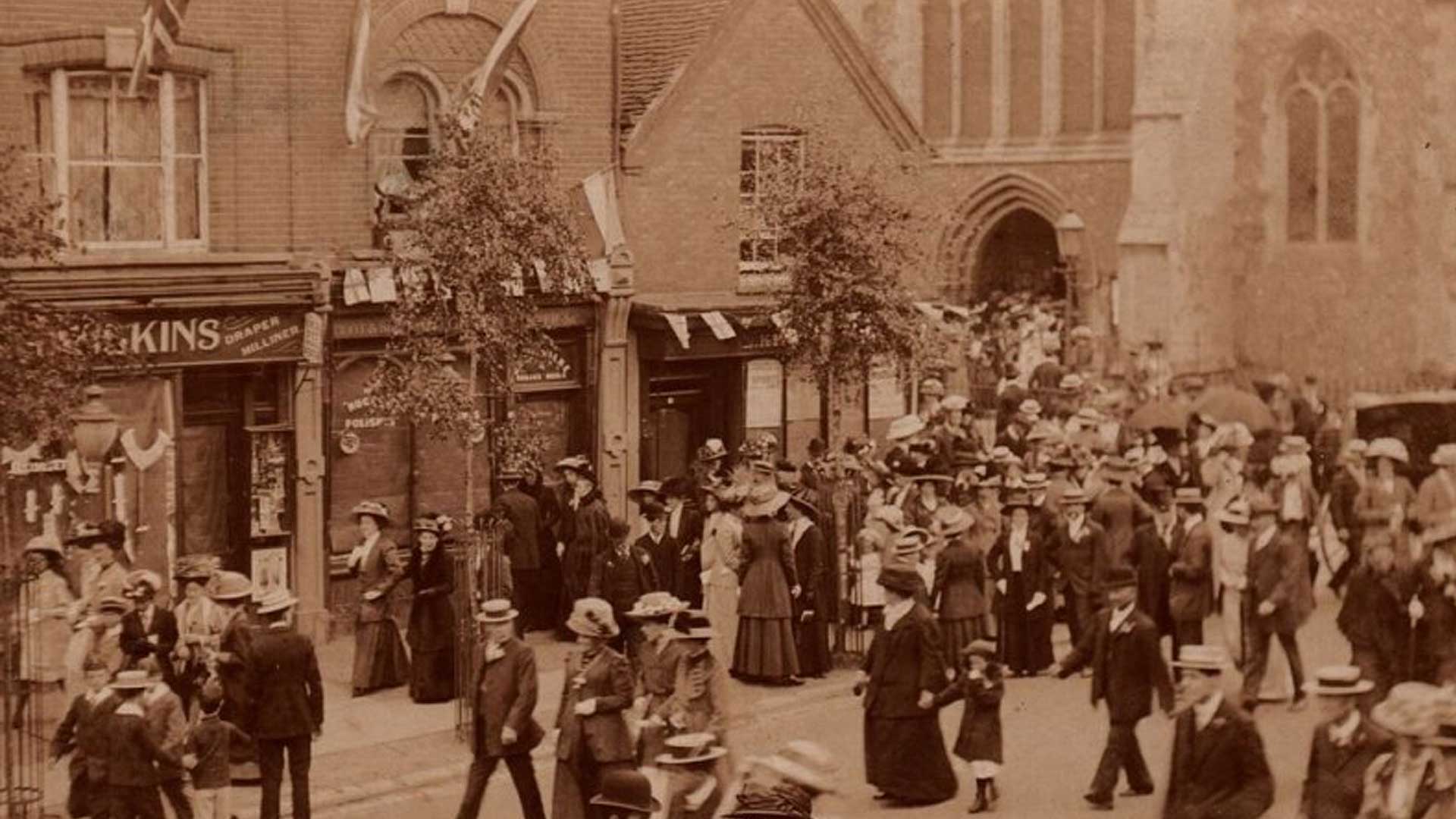
The Town Celebrates the 700th Anniversary of St Peter’s Church with a historical Pageant Play in Berkhamsted Castle, performed daily for 4 days in July. It rains during every performance except one. Parishioners dress up in historical costumes to reenact Berkhamsted’s history, and a choir sings A Song of Berkhamsted, specially composed for the pageant by Gilbert Hudson and Stanley Wilson.
The full 1922 programme
The novelist Graham Greene is born in Berkhamsted in 1904. His father, Charles Green, is headmaster of the Berkhamsted School from 1904. Greene mentions St Peter’s Church in some of his stories. In The Human Factor (1978), there is a brief scene inside St Peter’s in which a sonic boom suddenly “shook the old glass of the west window and rattled the crusader’s helmet which hung on a pillar”. The helmet is that of Sir Adolphus Carey (who actually lived around 300 years after the crusades).

In this 1920 photo we see how St Peter’s looked between Butterfield’s 1870 restoration and 1960. A large mural of the Ascension covers the wall over the tower arch. It was donated by the widow of Rector James Hutchinson in 1872, but had to be removed in the roof renovations of 1956-1960. Today, a small plaque on the wall commemorates this gift, even though the decorations it describes have all vanished. Similar murals of this period can still be seen at nearby churches such as St Peter and St Paul Tring and St Mary’s Edlesborough.
A renovation project begun in the late 1950s reveals a hidden problem – the medieval roof timbers are rotten and has to be replaced urgently! A fundraising campaign raises £24,000 (£480,000 in today’s money) for the restoration and re-ordering of St Peter’s. The old rotten roof is replaced with a concrete structure.

The 1960 renovation work introduces new heating, new lighting and a new organ. It also includes a major re-ordering of the sanctuary. A wooden 15th-Century rood screen which separated the nave from the crossing is moved back to create a partition wall, and the old chancel is turned into a vestry. The screen is painted and twelve 19th century carved wooden figures are added. The altar is now located under the crossing.

Queen Elizabeth II visits St Peter’s to unveil a newly-restored Coat of Arms of Elizabeth I, which hangs in St Peter’s Church, and the choirs of St Peter’s Church and the Berkhamsted School sing a short programme of choral pieces. The Queen then goes on to visit the Berkhamsted School, which is celebrating the 475th anniversary of its foundation by Dean Incent.

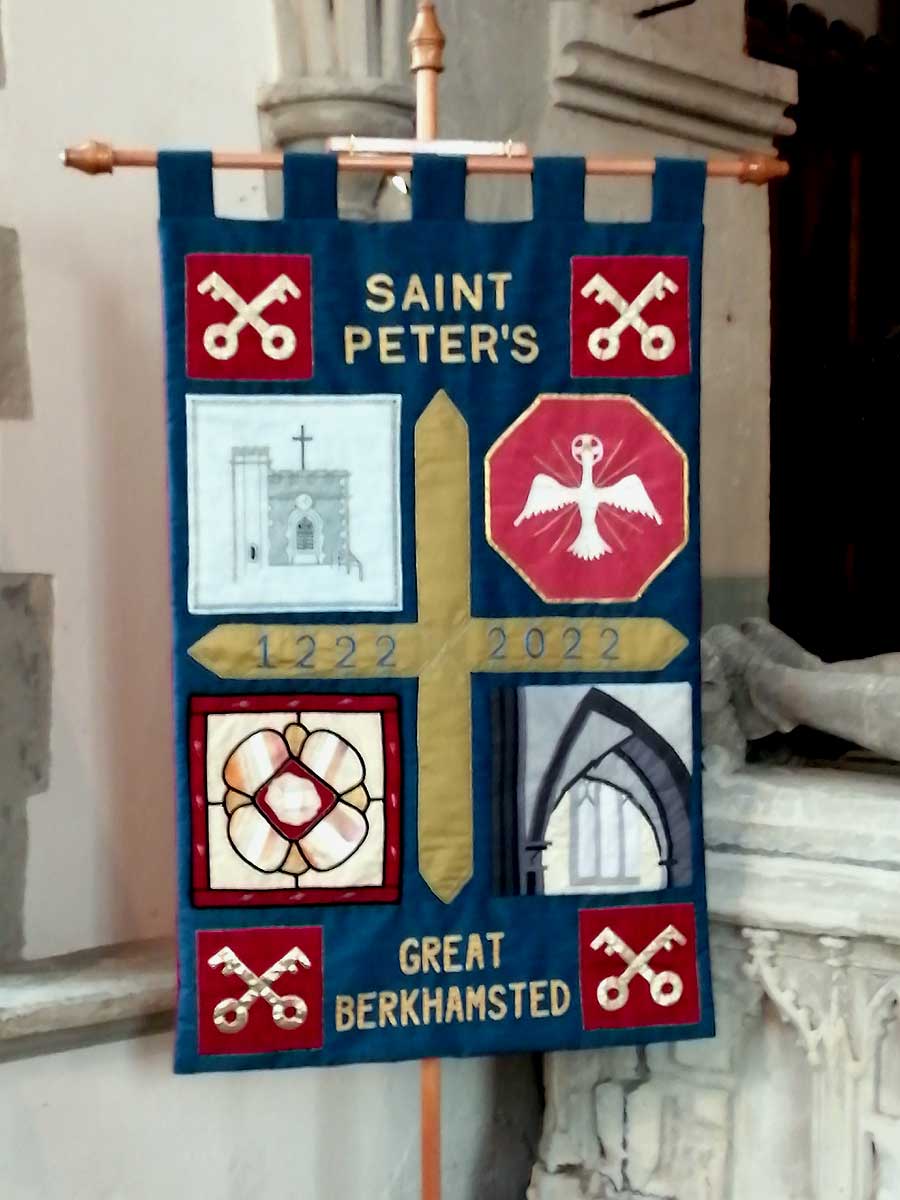
In 2022 we mark our 800th Anniversary with a year-long celebration of community events including a summer fête, concerts, hikes, ceilidhs, choral services, art workshops and photography exhibitions. On Advent Sunday, thousands visit our church to see it lit up by candles. This celebration reminds us of the importance of cherishing our heritage – it connect us with our forebears, enriches our present and inspires us for the future.