This fine example of Victorian stained glass is the work of Nathaniel Westlake, a leading designer of the Gothic Revival movement, although the Perpendicular stone tracery is probably 15th century. The window was installed in memory of William Cooper (1813-1885) — the manufacturer of the world-famous Cooper’s Sheep Dip in Berkhamsted in the 1850s, and not the 18th-century poet William Cowper (for memorials to the poet, see points 5, 15 and 22).
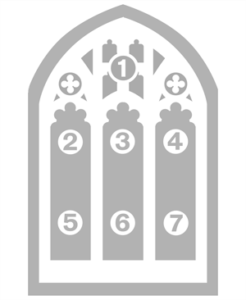
In the window lights, images of angels and saints are shown surrounding Christ. The saints’ names written faintly in their haloes. Several bear mottoes on scrolls of paper (a sort of medieval equivalent of cartoon speech bubbles) containing Latin quotes from the ancient Christian hymn, the Te Deum:
| 1 Top section | The small lights at the top contain figures of humans and angels bearing the mottoes: “Tibi omnes Angeli (proclemant)” – “To thee all Angels cry aloud” and “Te Prophetarum laudabilis numerus” – “The goodly fellowship of the Prophets praise thee”. |
| 2 Left light upper |  Two kneeling figures: Two kneeling figures:St John the Evangelist Motto: “Te gloriósus Apostolorum chorus” – “The glorious company of the Apostles praise thee” The Virgin Mary Motto: “Te per orbem terrárum sancta confitetur Ecclesia” – “The holy Church throughout all the world doth acknowledge thee” |
| 3 Central light middle |  Central figure: Christ Enthroned in Majesty, a traditional depiction of Jesus that dates back to the Early Church. Jesus is shown sitting on a throne in heaven after the Resurrection, his right hand raised in blessing. Christ’s hands and feet bear the scars of the Crucifixion, and above his head is the hand of God the Father pointing down in blessing. Central figure: Christ Enthroned in Majesty, a traditional depiction of Jesus that dates back to the Early Church. Jesus is shown sitting on a throne in heaven after the Resurrection, his right hand raised in blessing. Christ’s hands and feet bear the scars of the Crucifixion, and above his head is the hand of God the Father pointing down in blessing. |
| 4 Right light upper |  Two kneeling figures: Two kneeling figures:St Joseph, holding a wooden staff with liles blooming from the top. This symbol comes from a medieval story called The Golden Legend. Motto: “Te ergo quæsumus, tuis famulis subveni, quos pretioso sanguine redemísti” – “We therefore pray thee, help thy servants whom thou hast redeemed with thy precious blood.” St John the Baptist Motto: “Te Martyrum candidatus laudat exercitus” – The noble army of Martyrs praise thee. |
| 5 Left light lower |  Two English Saints: Two English Saints:King Edward the Confessor, one of the last Saxon Kings of England before the Norman Conquest; note Edward’s three-dimensional exquisitely jewelled robes in this window. St Hugh of Lincoln, 12th-century Bishop of Lincoln, who installed the first Rector of St Peter’s in 1222. Hugh (or Hugo) had a lasting friendship with a swan, which followed him everywhere. |
| 6 Central light lower |  Two Saints: Two Saints:St Clement (Pope Clement I), 1st-century pope, said to have been consecrated by Saint Peter himself. He is shown wearing the papal tiara and vestments and holding a papal cross. St Catherine of Alexandria, with the wheel of her martyrdom, the Catherine wheel, and carrying a palm branch, a symbol of martyrdom. There is also a chapel in St Peter’s Church dedicated to St Catherine. |
| 7 Right light upper |  Two Saints: Two Saints:St Leonard, who according to legend, freed prisoners from their chains, and he is traditionally depicted holding broken manacles. There are many churches dedicated to Leonard in Sussex and the Midlands St Thomas Beckett, England’s most famous saint who was murdered in Canterbury Cathedral; he is shown with a sword piercing his bishop’s mitre. In the mid-12th century, Thomas was in charge of Berkhamsted Castle. |
|
Try to find two hidden “NHW” signatures, the initials of Nathaniel Hubert Westlake, etched into the stained glass by the artist. |