The Totternhoe Stone tomb supporting the recumbent figures of a knight and his lady is thought to be that of Henry of Berkhamsted and his wife. Henry was Constable of Berkhamsted Castle in the mid-14th century and served with Edward the Black Prince in France at the Battles of Crécy (1346) and Poitiers (1356).
The tomb originally stood on the north side of the nave and has suffered some damage from being moved several times. The knight is represented in armour, his hands held in prayer, his head resting on a helmet and his feet supported by a lion. He wears a hood, a chain-mail gorget (collar) and a sash, upon which lies a rose; a dove symbol is on his breastplate. The lady wears an elegant dress, a hairnet and a rose on each shoulder.
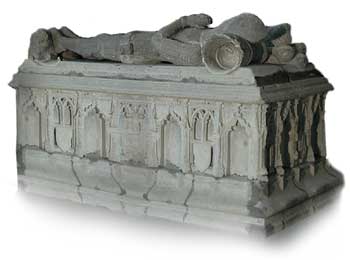
This was once thought to be the tomb of Richard and Margaret Torrington. The heraldic shields around the base include the crests of the Incent and Torrington families, suggesting that Henry may have been a member of the Torrington family, perhaps married to an Incent, or an Incent married to a Torrington. The heraldry also features the fork-tailed (queue fourchée) lion of the Burghersh family at the lady’s head. This may indicate a family link with Geoffrey Chaucer, clerk of works at Berkhamsted Castle in the 1380s, whose son married into the Burghersh family.
 Despite damage, this is a fine example of a medieval knight’s tomb. The historical scholar John Weever noted in his book Ancient Funerall Monuments(1631) that this tomb was painted in bright colours, and traces of red paint can still be seen inside Henry’s helmet even today.
 Edward the Black Prince is not buried in Berkhamsted but in Canterbury Cathedral – his bronze tomb (1376) is of a similar design to Henry’s and is well worth a visit.